
Multifocal Contact Lenses
Multifocal contact lenses, also known as varifocal contact lenses, are designed to help you see clearly at different distances, reducing the need to wear reading glasses over your contact lenses.
As we get older, our eyes gradually become less able to focus on close-up objects, a natural change called presbyopia. This can make everyday activities such as reading, using your phone or working at a computer more difficult.
Modern multifocal contact lenses offer a convenient alternative to varifocal glasses for many people. Available in daily, two-weekly and monthly disposable lenses as well as extended wear, they can help you enjoy everyday activities without the need for reading glasses.
Our guide explains how multifocal lenses work, the different options available and how to choose the right lenses for your needs.
What Are Multifocal Contact Lenses?
Multifocal contact lenses, sometimes called varifocal contact lenses, are designed to correct vision at more than one distance. Unlike standard single-vision contact lenses, which generally correct either short-sightedness or long-sightedness, multifocal lenses combine different prescription powers to help you see at three key distances:
- Near vision – reading a book, checking your phone or looking at a menu.
- Intermediate vision – working at a computer, cooking or viewing your car dashboard.
- Distance vision – driving, watching television or recognising someone across the room.
Why Do We Need Multifocal Contact Lenses?
As we reach our 40s, the natural lens inside the eye gradually loses flexibility, making it harder to focus on nearby objects. This age-related change is called presbyopia, and it affects almost everyone eventually, whether they already wear glasses or contact lenses.
You might notice yourself holding your phone further away to read messages, struggling with small print or needing reading glasses over your usual contact lenses.
Multifocal contact lenses can help you manage these changes, allowing you to continue enjoying the convenience of contact lenses as your eyes age.
How Do Multifocal Contact Lenses Work?
Multifocal contact lenses work by combining different prescription powers within a single lens. Rather than providing one fixed focusing power, they are designed to help you see at different distances.
This means you can move between everyday activities, such as reading a message on your phone, working at a computer and looking across the room, without continually reaching for reading glasses.
Different Multifocal Lens Designs
There are two common approaches to multifocal contact lens design:
- Concentric designs – use zones or rings with different prescription powers to support vision at different distances.
- Aspheric designs – use a gradual change in prescription power across the lens to provide a transition between viewing distances.
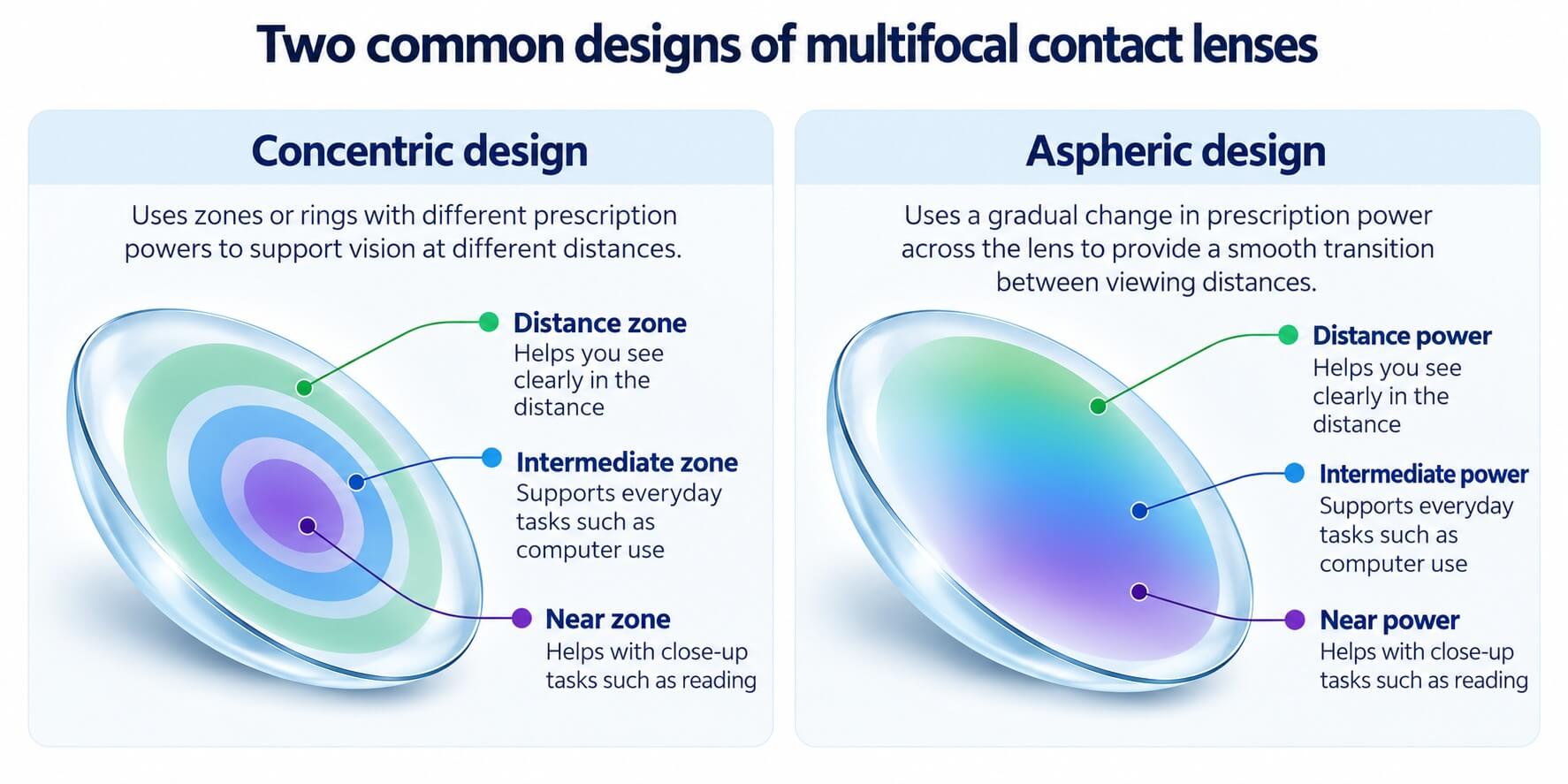
Many modern multifocal lenses use simultaneous-vision designs, allowing light from different distances to reach the eye at the same time. Your brain learns to favour the information needed for the task you're doing.
Because everyone's eyes and visual needs are different, your optometrist will recommend a suitable lens design and prescription. Some people adapt quickly, while others need a little more time or adjustments to achieve comfortable, useful vision.
Types of Multifocal Contact Lenses
Multifocal contact lenses are available in different replacement schedules and materials, making it easier to find an option that suits your lifestyle, prescription and wearing habits.
Daily Disposable Multifocal Contact Lenses
Daily disposable multifocal lenses offer the convenience of a fresh pair every day. Simply insert a new pair in the morning and dispose of them after use, with no cleaning solutions or storage cases required.
They're great if you don’t want to be bothered with a cleaning routine, and particularly convenient for occasional wearers and travellers. Popular options include 1 Day Acuvue Moist Multifocal and Dailies Total1 Multifocal.
Two-Weekly Multifocal Contact Lenses
Two-weekly multifocal lenses are replaced every 14 days from opening, according to the manufacturer's replacement schedule. Unlike daily disposables, they need to be cleaned and stored in fresh contact lens solution after each day's wear.
ACUVUE OASYS Multifocal is an example of a two-weekly multifocal lens, offering an alternative for people who prefer a reusable lens with a shorter replacement schedule than monthly lenses.
Monthly Multifocal Contact Lenses
Monthly multifocal contact lenses are designed to be replaced after 30 days, not necessarily 30 individual wears. They must be removed, cleaned, and stored correctly each evening.
Monthly lenses can be a practical and economical option for people who wear contact lenses regularly. Popular choices include Biofinity Multifocal and Air Optix plus HydraGlyde Multifocal.
Extended Wear Multifocal Contact Lenses
Some multifocal contact lenses are approved for extended wear, meaning they may be worn overnight for a specified period when professionally prescribed.
Certain monthly multifocal lenses, such as Biofinity Multifocal, may be suitable for extended wear, depending on the manufacturer's approval and your optometrist's assessment.
Important: Sleeping in contact lenses increases the risk of eye infections. Never sleep in your multifocal lenses unless your optometrist has specifically confirmed that the lenses and wearing schedule are suitable for your eyes.
Hydrogel and Silicone Hydrogel Multifocal Lenses
Multifocal contact lenses are available in two main soft lens materials: hydrogel and silicone hydrogel.
Hydrogel lenses allow oxygen to reach the eye largely through the water contained within the lens.
Silicone hydrogel lenses also contain water, but the addition of silicone allows significantly more oxygen to pass through the lens to the cornea, without requiring a particularly high water content.
Both materials can provide comfortable vision. The best choice depends on your individual eyes, prescription and how you wear your contact lenses.
Which Multifocal Contact Lenses Are Right for You?
Choosing the right multifocal contact lenses depends on your prescription, eye health, lifestyle and personal preferences. Some people prioritise the convenience of daily disposables, while others prefer the economy of monthly lenses or have particular comfort requirements.
Our recommendations highlight suitable options for different needs, but your optometrist should confirm which lenses are appropriate for your eyes.
| Best For | Contact Lens | Replacement | Why We Recommend It |
|---|---|---|---|
| Best Daily | Dailies Total1 Multifocal | Daily | Premium silicone hydrogel lens with water-gradient technology, designed to support comfortable vision throughout the day |
| Best Monthly | Biofinity Multifocal | Monthly | Breathable silicone hydrogel material and a multifocal design that supports vision at different distances |
| Best Value Daily | Clariti 1 Day Multifocal | Daily | Our lowest-priced daily multifocal option, combining silicone hydrogel technology with an affordable price |
| Best Value Monthly | Bausch + Lomb ULTRA for Presbyopia | Monthly | Our most competitively priced silicone hydrogel multifocal with MoistureSeal technology |
| Best Comfort Overall | Clariti 1 Day Multifocal | Daily | Recommended by our Optometrist; WetLoc technology helps retain moisture to support comfortable wear |
| Best Overall | Dailies Total1 Multifocal | Daily | Combines premium water-gradient technology, high oxygen transmission and the convenience of a fresh pair every day |
These recommendations are intended as a guide. Individual comfort and visual performance vary, and contact lenses should always be professionally fitted.
How Much Do Multifocal Contact Lenses Cost?
Multifocal contact lenses are generally more expensive than standard single-vision lenses because their more complex designs help correct vision at different distances within one lens.
Daily disposable multifocals offer convenience without cleaning solutions, while two-weekly and monthly replacement lenses can be more economical for regular wearers.
When comparing prices, it's worth looking beyond the cost of a single box. Daily lenses are usually sold in packs of 30, while reusable lenses may come in packs of three or six. The number of lenses you need each month will depend on how often you wear them.
Multifocal Contact Lens Price Comparison
The table below compares popular multifocal and varifocal contact lenses, including daily, two-weekly and monthly options.
| Contact Lens | Replacement | Pack Size | Box Price | Daily Wearing Cost |
|---|---|---|---|---|
| Clariti 1 Day Multifocal – New | Daily | 30 | £32.34 | £2.16 |
| Proclear 1 Day Multifocal | Daily | 30 | £40.79 | £2.72 |
| Dailies AquaComfort Plus Multifocal | Daily | 30 | £32.99 | £2.20 |
| Dailies Total1 Multifocal | Daily | 30 | £44.95 | £3.00 |
| ACUVUE OASYS Multifocal | Two-weekly | 6 | £59.00 | £1.74 |
| Bausch + Lomb ULTRA for Presbyopia | Monthly | 3 | £34.95 | £1.11 |
| Biofinity Multifocal | Monthly | 3 | £41.40 | £1.25 |
| Proclear Multifocal | Monthly | 3 | £43.20 | £1.29 |
Daily wearing costs are estimates for both eyes, based on everyday wear over 30 days. Costs for two-weekly and monthly lenses include approximately 33p per day for Renu Multi Purpose Solution (£10 per month), including the supplied contact lens case. Actual costs may vary depending on your wearing schedule.
Are Daily or Monthly Multifocal Contact Lenses Cheaper?
For someone wearing contact lenses every day, monthly multifocals are often the more economical choice, even after allowing for cleaning solutions and storage cases.
However, if you only wear contact lenses occasionally, daily disposables may offer better value because you only use a fresh pair when needed, with no ongoing cleaning or storage requirements.
The best option for you my not necessarily be the cheapest box. It's the lens that suits your prescription, wearing habits, and budget.
Understanding Your Multifocal Contact Lens Prescription
A multifocal contact lens prescription contains many of the same measurements as a standard contact lens prescription, but it also includes additional information to help correct your vision at different distances.
At first glance, the numbers and abbreviations can seem confusing. Here's what they mean.
| Abbreviation | What It Means |
|---|---|
| SPH (Sphere) | Your lens power, used to correct short-sightedness (minus numbers) or long-sightedness (plus numbers). |
| BC (Base Curve) | The curvature of the contact lens, measured in millimetres. |
| DIA (Diameter) | The width of the contact lens, measured in millimetres. |
| ADD (Addition) | The additional reading power required to help with near vision. |
| D/N (Distance/Near) | A designation used by some multifocal lens brands to indicate distance- or near-centred lens designs. Not all multifocal lenses use this marking. |
Understanding ADD Powers: LOW, MED and HIGH
The ADD value describes the additional near-vision correction required for presbyopia.
Some multifocal contact lenses use a numerical ADD value, such as +1.00, +1.50, or +2.00. Other brands use categories such as LOW, MED or HIGH.
These categories are not necessarily equivalent between manufacturers. For example, a MED ADD in one brand may not provide exactly the same near-vision correction as a MED ADD in another.
Your optometrist will determine the appropriate ADD power and lens design based on your prescription and visual needs.
Example of a Multifocal Contact Lens Prescription
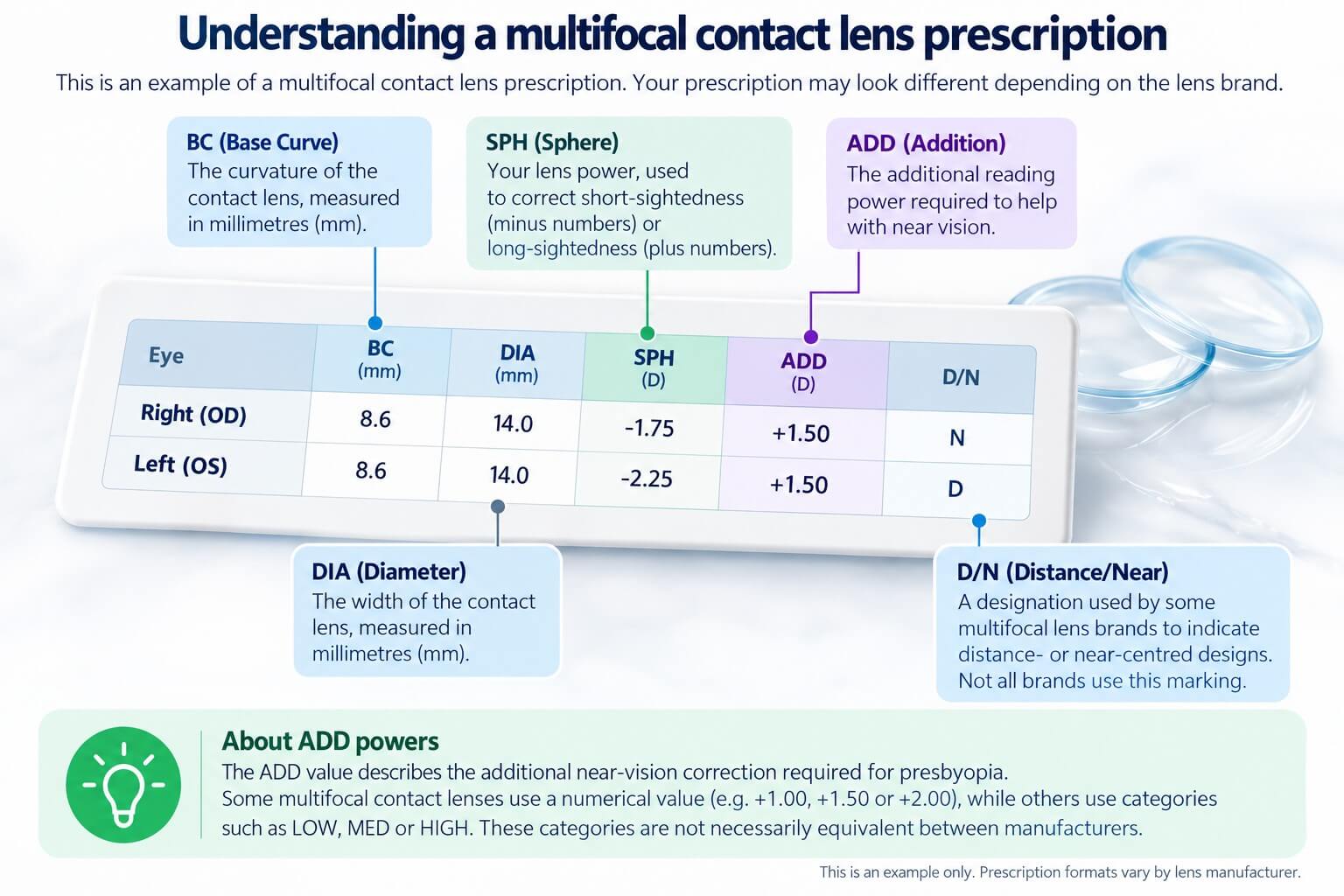
In this illustrative example, both eyes require correction for distance vision, together with an additional +1.50 reading power.
The ADD value is particularly important because it helps determine the near-vision correction needed for activities such as reading, checking your phone, and using a computer.
Some multifocal lens designs also specify a distance (D) or near (N) designation. This depends on the manufacturer and lens design, so you won't necessarily see these letters on every prescription.
Can I Use My Glasses Prescription to Order Multifocal Contact Lenses?
No. Even if you wear varifcal glasses, your glasses prescription and contact lens prescription are not interchangeable.
Contact lenses sit directly on the eye and require additional measurements and a professional fitting to ensure the correct lens design, prescription, and fit.
If you're considering multifocal contact lenses for the first time, your optometrist can assess your vision at different distances and recommend suitable lenses. Once you've been fitted, you should order the exact contact lenses and specifications prescribed for you.
Getting Used to Multifocal Contact Lenses
If you're new to multifocal contact lenses, it's normal for your eyes and brain to need a little time to adjust. Unlike single-vision lenses, multifocals combine different focusing powers to help you see at different distances.
Most people adapt within a few days to a couple of weeks, although everyone's experience is different. During this time, you may notice that your vision is clearer at some distances than others, particularly in low lighting or when switching between near and distant objects.
Tips for Adjusting to Multifocal Contact Lenses
- Give yourself time: Wear your lenses according to the schedule recommended by your optometrist. Consistent use can help you become familiar with your new vision.
- Use good lighting: Reading small print or carrying out detailed tasks is often easier in bright, comfortable lighting.
- Take regular screen breaks: When using a computer or digital device, remember to blink fully and follow the 20-20-20 rule to help reduce eye strain and dryness.
- Keep realistic expectations: Multifocal lenses aim to provide comfortable vision at different distances, but some people may still need reading glasses occasionally for very small print or particularly intricate tasks.
- Attend your follow-up appointment: Your optometrist can assess how well your lenses are working and make adjustments if your vision isn't as good as it could be.
When to Seek Advice
Some visual adjustment is normal, but persistent blurred vision or discomfort shouldn't be ignored. Remove your lenses and consult your optometrist.
If you experience eye pain, significant redness, sensitivity to light or sudden changes in vision, remove your lenses and seek urgent eye care.
With the right fitting, realistic expectations and a little patience, multifocal contact lenses can provide a convenient way to manage presbyopia.
Frequently Asked Questions About Multifocal Contact Lenses
Can multifocal contact lenses correct both near and distance vision?
Yes. Multifocal contact lenses are designed to help you see at different distances, often without needing separate reading or distance glasses. They use different focusing powers within the same lens, although the clarity achieved at each distance varies between individuals.
Are multifocal contact lenses suitable for astigmatism?
Yes, some people with astigmatism can wear multifocal contact lenses. Depending on the degree of astigmatism, your optometrist may recommend standard multifocal lenses or specially designed toric multifocal lenses, which correct both astigmatism and presbyopia. A professional fitting is essential to determine the most suitable option.
How long does it take to get used to multifocal contact lenses?
Many people adjust to multifocal contact lenses within a few days to a couple of weeks. During this time, your brain learns to adapt to the different focusing powers. If your vision remains unclear or you're struggling with particular tasks, your optometrist may need to adjust your prescription or lens design.
Can I drive while wearing multifocal contact lenses?
Yes, provided your multifocal contact lenses give you vision that meets the legal driving standard. Some wearers notice reduced clarity or increased glare when driving at night, particularly during the adjustment period. If you're unsure about your vision, avoid driving until your optometrist has assessed it.
Why is my vision blurry with multifocal contact lenses?
Blurred vision can occur during the initial adjustment period, but it may also indicate that your lens prescription, fit, or design needs refining. Dry eyes can also affect visual clarity. If blurring persists, remove your lenses and consult your optometrist rather than continuing to wear uncomfortable or poorly performing lenses.
Are daily or monthly multifocal contact lenses better?
Neither is automatically better. Daily disposable multifocals offer convenience and a fresh pair each day, making them particularly suitable for occasional wear. Monthly multifocals may be more economical for regular wear but require daily cleaning and proper storage. Your prescription, lifestyle and eye health will help determine which option suits you best.
Will I still need reading glasses with multifocal contact lenses?
Possibly. Multifocal contact lenses are designed to provide clear vision at all distances, some people still find reading glasses helpful for very small print, detailed close-up work or reading in poor lighting.
